
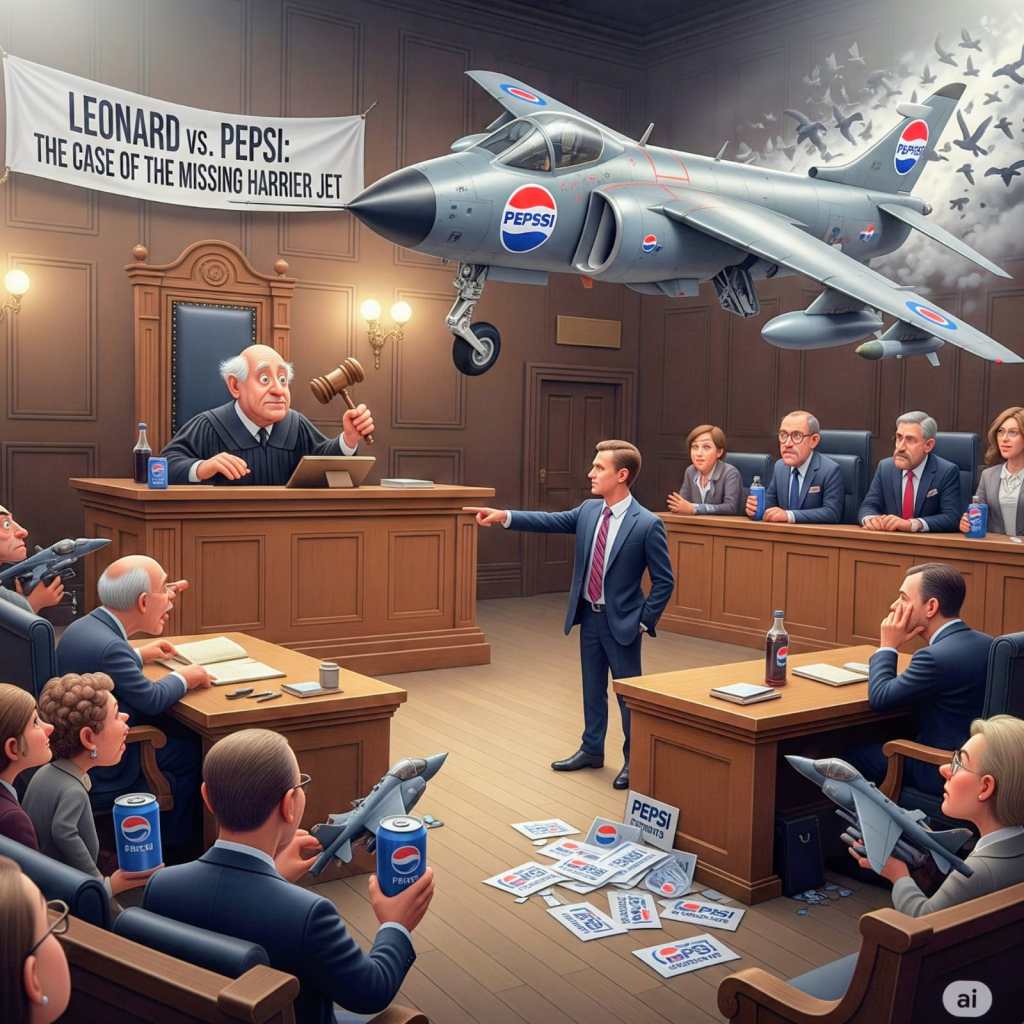
John Leonard vs Pepsi: The Case That Redefined Advertising Law
Background and Context
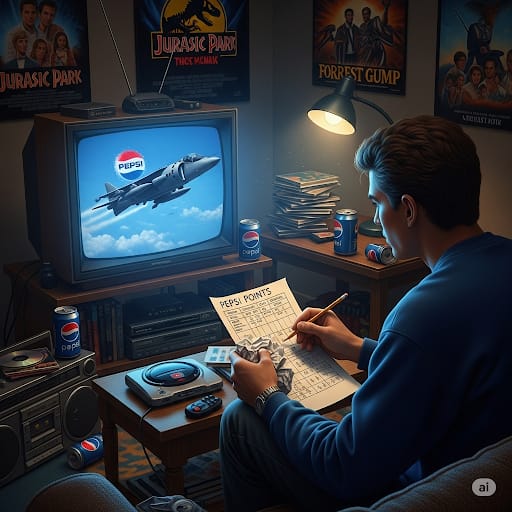
In the mid-1990s, PepsiCo launched one of its most ambitious marketing campaigns in company history: the “Pepsi Stuff” promotional program. This loyalty program allowed customers to collect “Pepsi Points” by purchasing Pepsi products, which could then be redeemed for branded merchandise like T-shirts, leather jackets, and sunglasses. The campaign was designed to attract younger consumers and compete more effectively with Coca-Cola during the height of the “cola wars”.
The trouble began with a television commercial that would become legendary in advertising law. The 45-second spot featured a teenager arriving at school in various Pepsi-branded items, each with its corresponding point value displayed on screen. The commercial climaxed with the same teenager landing at his high school in a McDonnell Douglas AV-8B Harrier II jump jet, quipping “Sure beats the bus!”. The screen displayed “Harrier Fighter 7,000,000 Pepsi Points”.
At the time, a genuine Harrier jet was valued at approximately $37.4 million. Most viewers understood the commercial as hyperbolic humor—classic advertising puffery. However, 21-year-old business student John Leonard from Seattle saw something else entirely: a business opportunity.
What Transpired: Leonard’s Bold Gambit

Leonard quickly realized that collecting 7 million Pepsi Points through product purchases would be virtually impossible. However, he discovered a crucial detail buried in the promotional materials: Pepsi Points could be purchased directly for 10 cents each. This meant the Harrier jet could theoretically be obtained for $700,000—a bargain compared to its $37.4 million market value.
Acting like the entrepreneur he was studying to become, Leonard convinced five investors, including automobile dealership owner Todd Hoffman, to provide the necessary funds. In March 1996, Leonard sent PepsiCo a check for $700,008.50 (covering 7 million points plus $10 shipping and handling) along with 15 actual Pepsi Points and an official order form requesting delivery of one Harrier jet.
PepsiCo’s response was swift and unambiguous: they rejected Leonard’s claim, returned his uncashed check, and offered him two Pepsi coupons instead. The company explained that the jet was featured for “entertainment purposes” and was “clearly a joke”. Jeff Mordos, an account manager for Pepsi’s advertising agency, later reflected: “Hundreds of millions of people saw the ad, and there’s one guy who says this was a serious offer? That was ridiculous”.
The Legal Battle Unfolds
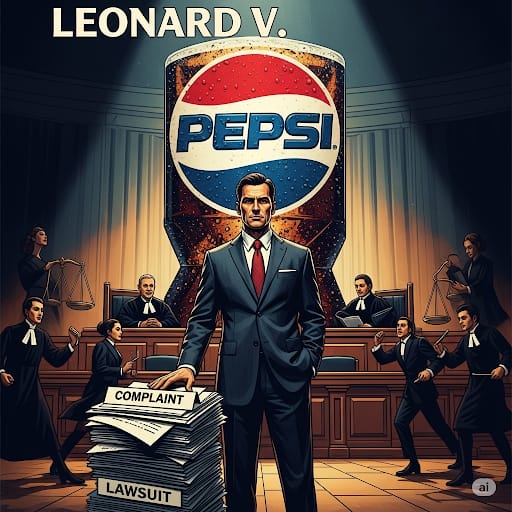
Undeterred by PepsiCo’s refusal, Leonard filed a lawsuit in federal court, initially in Florida before the case was transferred to the Southern District of New York. Leonard’s legal team, which at one point included Michael Avenatti (before his later legal troubles), argued that the commercial constituted a valid unilateral contract offer. According to their argument, Leonard had properly accepted this offer by tendering the required points and payment.
PepsiCo countered with a motion for summary judgment, arguing that the commercial was obviously satirical and that no reasonable person could believe the company was seriously offering a military aircraft as a promotional prize.
The Court’s Decision
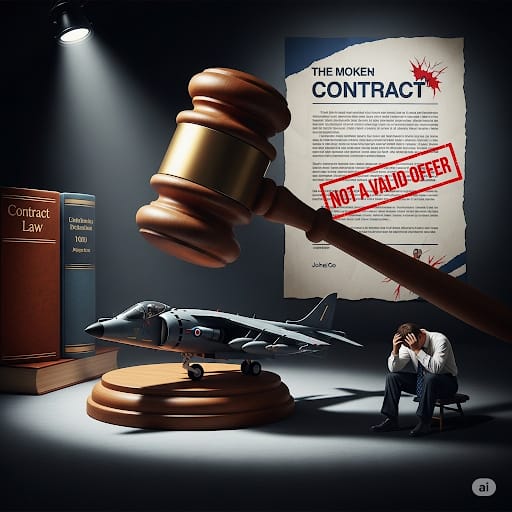
In August 1999, Judge Kimba M. Wood of the U.S. District Court for the Southern District of New York ruled decisively in favor of PepsiCo. Her comprehensive opinion rejected Leonard’s claims on multiple legal grounds:
No Valid Offer: The court found that the advertisement did not constitute a legally binding offer under contract law principles. Judge Wood noted that advertisements are generally considered invitations to negotiate rather than formal offers.
Reasonable Person Standard: Most crucially, the court applied the “reasonable person” test, concluding that “no objective person could reasonably have concluded that the commercial actually offered consumers a Harrier jet”. Judge Wood wrote that the commercial was “evidently done in jest” and that “the notion of traveling to school in a Harrier Jet is an exaggerated adolescent fantasy”.
Practical Impossibility: The court made several pointed observations about the absurdity of the scenario, noting that “the callow youth featured in the commercial is a highly improbable pilot” and that “no school would provide landing space for a student’s fighter jet”. Additionally, the Pentagon had stated that Harrier jets would not be sold to civilians without complete “demilitarization”.
Statute of Frauds: The court also ruled that even if a contract existed, it would be invalid under New York’s Statute of Frauds, which requires written agreements for the sale of goods exceeding $500.
Leonard appealed the decision to the U.S. Court of Appeals for the Second Circuit, but the appellate court affirmed Judge Wood’s ruling in a brief opinion stating they agreed “for substantially the reasons stated in Judge Wood’s opinion”.
The Aftermath and Results
Following the lawsuit, PepsiCo made several strategic adjustments to prevent future legal complications. The company updated its commercial to increase the Harrier jet’s “price” from 7 million to 700 million Pepsi Points and added a disclaimer reading “Just Kidding”. However, they never cashed Leonard’s original check, which eliminated any potential fraud claims.
Leonard received no compensation from the lawsuit and was responsible for his own legal fees. Despite the legal defeat, he maintained years later that he still believed the original offer was legitimate, telling Netflix’s documentary crew: “From a long-tenured federal judge’s perspective, it may not have seemed like a legitimate offer, but I can tell you, millions of my peers saw the commercial and thought it was an offer”.
What We Can Learn From This Case
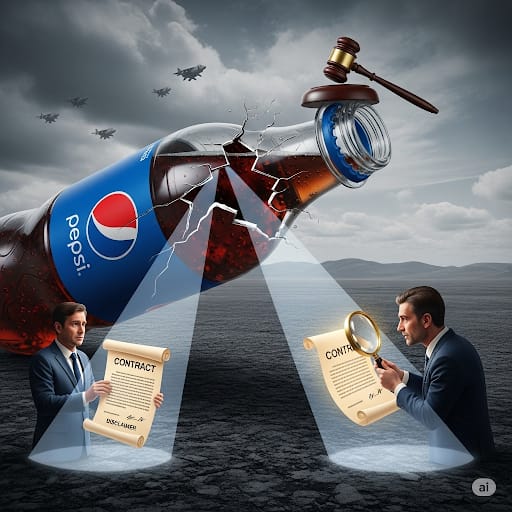
The Leonard v. PepsiCo case has become a landmark decision in contract law and advertising regulation, offering several crucial lessons:
The Power of the Reasonable Person Standard: The case reinforced that courts will evaluate advertising claims based on what a hypothetical reasonable consumer would understand, not the subjective interpretation of individual viewers. This standard helps protect companies from frivolous lawsuits while still holding them accountable for genuinely deceptive practices.
Puffery vs. Legitimate Offers: The decision clarified the legal distinction between advertising puffery (exaggerated promotional language that no reasonable person would take literally) and actual contractual offers. This helps advertisers understand the boundaries of creative marketing while protecting consumers from truly misleading claims.
Importance of Context in Advertising: Judge Wood’s opinion emphasized that advertisements must be evaluated within their proper context. The humorous, exaggerated nature of the Pepsi commercial, combined with the practical impossibility of the offer, made it clear that no serious contractual relationship was intended.
Need for Clear Communication: Following the case, many companies began including more explicit disclaimers in their advertising to avoid similar misunderstandings. The case highlighted the importance of clear communication between advertisers and consumers, especially in promotional campaigns.
Educational Value for Contract Law: Leonard v. PepsiCo has become one of the most frequently cited cases in law school contracts courses. It serves as an excellent teaching tool for understanding offer and acceptance, mutual assent, and the objective theory of contracts.
Consumer Protection Balance: The case demonstrates how courts balance protecting consumers from deceptive advertising while avoiding the creation of liability for obviously humorous or exaggerated marketing claims. This balance is crucial for maintaining both fair business practices and creative advertising freedom.
The Leonard v. PepsiCo case ultimately stands as a testament to the complexity of modern advertising law and the importance of applying common-sense standards to unusual legal situations. While John Leonard’s entrepreneurial spirit was admirable, his case helped establish important precedents that continue to guide courts, advertisers, and consumers in distinguishing between legitimate offers and creative marketing hyperbole.
The Irony
Leonard later admitted he knew Pepsi wouldn’t deliver the jet. He’d hoped for a settlement or free publicity for his startup. Instead, he became a cautionary tale about literalism in marketing. As Judge Wood quipped:
“If Pepsi intended the commercial as a joke, the humor was lost on Leonard.”
Today, the case reminds us: when an ad seems too insane to be true, it’s probably not a contract – just a punchline.
Sources:
- https://en.wikipedia.org/wiki/Leonard_v._Pepsico,_Inc.
- https://law.justia.com/cases/federal/district-courts/FSupp2/88/116/2579076/
- https://simpleflying.com/pepsi-points-fighter-jet-story/
- https://www.netflix.com/tudum/articles/leonard-v-pepsico
- https://en.wikipedia.org/wiki/Pepsi,_Where’s_My_Jet%3F
- https://www.bolandaarab.com/flying-high-on-false-advertising/
- https://studicata.com/case-briefs/case/leonard-v-pepsico-inc/
- https://profspeak.com/pepsi-and-the-jet-a-lesson-in-contracts/
- https://www.edvido.com/blog/top-insights-into-the-famous-pepsi-case-leonard-v-pepsico-explained
- https://www.upcounsel.com/is-an-advertisement-a-contract
- https://courses.lumenlearning.com/suny-monroe-law101/chapter/elements-of-a-contract/
- https://legalvision.com.au/what-is-puffery-and-when-will-it-get-you-into-trouble/
 Vedic Astrology
Leave a comment