


First Principles Thinking: A Foundation for Critical Thinking and Problem-Solving
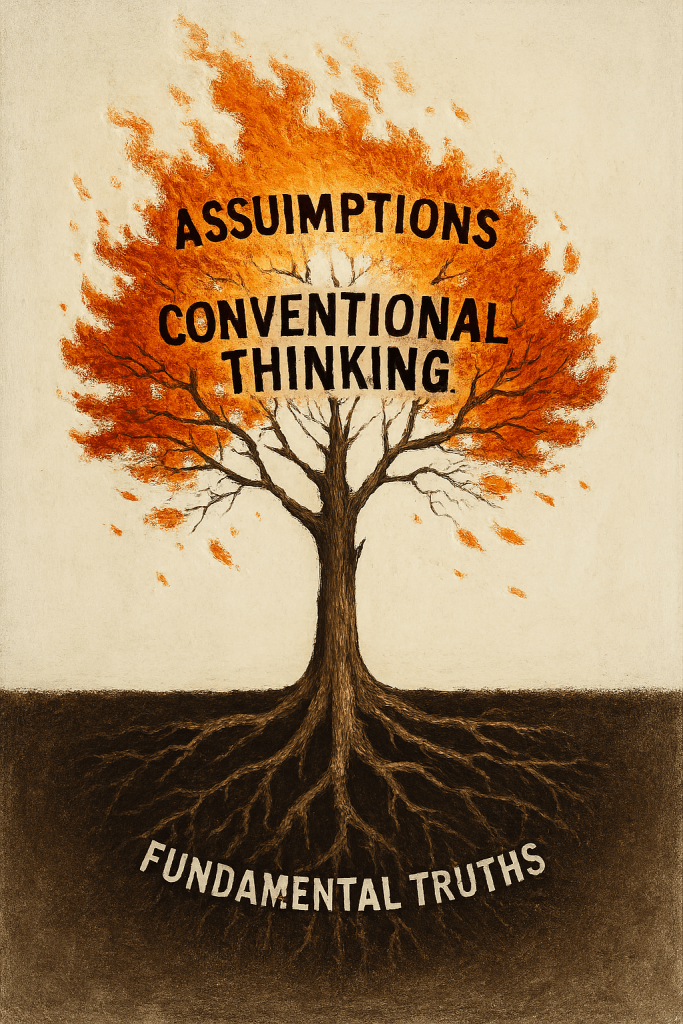
Have you ever found yourself doing something just because “that’s how it’s always been done”? We all fall into this trap, relying on assumptions and analogies instead of questioning the status quo. This is where first principles thinking comes in. It’s a mental model that empowers you to break down complex problems into their most basic, fundamental truths and then build innovative solutions from the ground up, unburdened by conventional wisdom.
First principles thinking, also known as reasoning from first principles, is a highly effective strategy for breaking down complex problems and generating original solutions. It involves delving into the foundational truths of a situation, questioning every assumption, and building knowledge from these basic, undeniable elements. Elon Musk is noted as a prominent figure who embodies this philosophy effectively.
I wanted to apply it for a product development exercise for my business.
What is First Principles Thinking?
First principles thinking is a problem-solving strategy that has its roots in ancient Greek philosophy, notably with thinkers like Aristotle. Instead of reasoning by analogy—comparing a new problem to a familiar one and making slight tweaks—you dissect the problem to its core components. A first principle is a foundational truth, something that cannot be broken down any further. This approach forces you to ask “why” repeatedly until you arrive at the most basic, irreducible facts.
- Defining the Core: It means boiling a process or problem down to its most fundamental parts that are known to be true. A first principle is a basic assumption that cannot be deduced any further.
- Thinking Like a Scientist: As articulated by Aristotle over two millennia ago, a first principle is “the first basis from which a thing is known”. This approach encourages thinking like a scientist, starting with questions like, “What are we absolutely sure is true? What has been proven?” rather than accepting assumptions.
- Deconstruct and Reconstruct: The methodology involves a cycle of deconstructing a situation into its core pieces and then reconstructing them in a more effective way. This might mean going “one or two levels deeper than most people” typically would.
Methodology and Application:

Elon Musk frequently approaches challenges from a “physics framework,” reasoning from first principles instead of relying on analogy. Key aspects of this methodology include:
- Questioning Requirements: Begin by challenging the requirements of a task, as they are “always dumb to some degree”. The goal is to make the question “the least wrong possible”.
- Deleting Steps: Actively try to remove parts or process steps entirely. A rule of thumb is that if you are not forced to reintroduce at least 10% of what you deleted, you haven’t deleted enough.
- Optimising Last: Only after critically questioning and deleting elements should one proceed to “optimize it or simplify it”. A common pitfall for intelligent engineers is to “optimize a thing that should not exist”.
- Thinking in the Limit: This physics tool involves scaling a problem to very large or very small numbers to understand its core dynamics. For instance, to assess a product’s cost, one might ask if it would still be expensive if produced at a million units a year. If the answer is yes, then low volume isn’t the issue; a fundamental design problem or inefficiency in manufacturing is.
- Raw Material Cost Analysis: For products like rockets, Musk would break down their cost to the raw materials (e.g., aluminium, steel, titanium, copper, carbon fibre) and their commodity market value. This often reveals that the actual raw material cost is a tiny fraction (e.g., 1-2%) of the final price, indicating massive inefficiencies in the manufacturing process.
Importance in Critical Thinking and Problem-Solving:
First principles thinking is crucial for critical thinking and problem-solving due to several reasons:
- Fosters Originality and Innovation: It is instrumental in generating original solutions and driving groundbreaking innovation. By combining disparate ideas from unrelated fields, new inventions can emerge, such as a snowmobile from parts of a motorboat, tank, and bicycle. This approach enabled SpaceX to dramatically cut rocket launch costs by building rockets from raw materials rather than purchasing expensive finished products.
- Challenges Assumptions and Promotes Rigorous Analysis: It compels individuals to move beyond inherited ideas, old conventions, and reasoning by analogy. Instead, it demands a deep understanding of fundamental truths, ensuring that solutions are logically sound and not based on potentially flawed precedents. This rigorous adherence to truth is considered paramount, especially in fields like AI development.
- Enhances Efficiency and Optimisation: By dissecting problems to their essence, this approach can lead to significant cost reductions and efficiency improvements. Identifying whether high costs stem from design flaws or merely low production volume guides efforts toward genuine optimisation.
- Overcomes Perceived Impossibility: First principles thinking empowers individuals to tackle problems that others deem “impossible”. For example, the vision of a rapidly and completely reusable orbital transport system for Mars, initially appearing borderline impossible, becomes feasible when broken down into its constituent, solvable engineering challenges based on physics principles. Elon Musk noted that until recently, he wasn’t convinced a self-sustaining Mars colony was even a “possible outcome,” but this approach confirmed its feasibility.
- Broad Applicability: The analytical tools derived from physics and first principles can be applied “broadly in life” and “really any arena,” encompassing both software and hardware development. It serves as a “superpower” for making progress and is the most effective way to determine if an idea is truly sound or merely following existing trends.
First principles thinking isn’t just for rocket scientists or tech billionaires. It’s a valuable tool for anyone who wants to solve problems in a truly innovative way, whether in business, education, or your personal life. By consistently questioning your assumptions and building your understanding from the ground up, you can unlock creativity and discover solutions that others miss.
 Vedic Astrology
Leave a comment