
Morning Vs Evening
If you think dragging your young athlete out of bed at the crack of dawn builds character and champions, science has some shocking news for you. While the “rise and grind” mentality looks great on motivational posters, forcing a 10-year-old onto the badminton court at 4:30 AM might actually be holding them back. Extensive research in chronobiology and sports science reveals that early morning is the absolute worst time for high-intensity athletic performance and skill acquisition. If you want to unlock your child’s true potential, it’s time to trade the pre-dawn alarm for a prime-time afternoon smash.
The Temperature Trap: Warming Up the Biological Engine
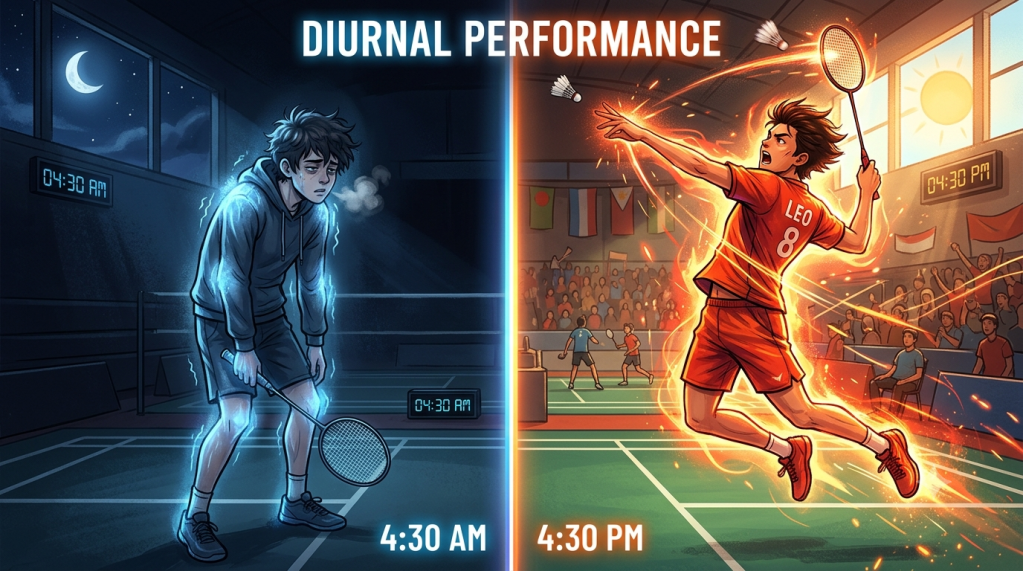
Human physical performance fluctuates directly with our core body temperature, which acts as the body’s internal thermostat for athletic capability. Between 4:00 AM and 6:00 AM, a child’s core body temperature hits its lowest biological point. At this icy nadir, muscles are stiff, joints lack flexibility, and nerve conduction velocity—the speed at which signals travel from the brain to the muscles—is significantly slowed down.
By contrast, core body temperature and neuromuscular function naturally peak between 4:00 PM and 8:00 PM. Pushing an elite, explosive sport like badminton at 4:30 AM forces a young player to execute high-velocity movements when their body is literally in a state of biological lockdown. Training at 4:30 PM ensures their muscles are naturally warm, flexible, and firing at maximum capacity, drastically reducing the risk of injury while boosting raw power.
Precision and Power: The Science of the Perfect Smash
Badminton demands split-second reaction times, flawless visual tracking, and razor-sharp tactical execution. A landmark sports science study published in Current Biology revealed that athletic performance varies by up to 26% throughout the day based on our internal clocks. In the early morning, athletes suffer from “sleep inertia”—the groggy transition state of the brain—which severely impairs spatial awareness and visual reaction times.
Furthermore, data published in Science for Sport demonstrates that muscle strength, anaerobic power (crucial for explosive court lunges), and sprinting capacity are all notably greater in the evening. In fact, studies show that athletes take up to 20% longer to reach the point of exhaustion when training in the late afternoon compared to the morning. At 4:30 PM, your child can train harder, run faster, and jump higher with a lower perceived rate of exertion. At 4:30 AM, their body expends an enormous amount of energy just resisting the natural urge to sleep.

The Sleep Tax: Protecting Muscle Memory and Growth
The absolute biggest threat of the 4:30 AM workout isn’t just bad timing; it’s severe sleep deprivation. A 10-year-old athlete requires 9 to 11 hours of uninterrupted sleep for healthy development. Waking up at 4:00 AM systematically sabotages the final two hours of their night sleep cycle. These final morning hours are densely packed with REM (Rapid Eye Movement) sleep, which is the exact phase where the brain processes motor learning and solidifies the muscle memory of the techniques learned during practice.
By cutting sleep short, the brain cannot effectively consolidate the badminton footwork and racket skills from the day before. An NCAA study confirmed that early morning sessions contribute heavily to chronic sleep restriction, leading to chronic fatigue, stunted growth, and a spike in injury rates. Dropping the morning session and letting a young player sleep uninterrupted from 9:30 PM to 7:00 AM guarantees 9.5 hours of glorious, growth-inducing recovery.

Conclusion
When we stack the data side-by-side, the evening session wins in a landslide. Training at 4:30 PM captures peak core body temperature, optimal hand-eye coordination, and maximum time to exhaustion, all while protecting the critical sleep hours a 10-year-old desperately needs to grow and recover. While early morning sessions have a minor place for older athletes adjusting to specific morning tournament schedules, they simply do not belong in a child’s daily routine. By shifting the primary focus to high-quality afternoon training, you give your young athlete a sharper mind, a stronger body, and a much happier relationship with the sport.
Are we coaching our young athletes based on proven sports science, or are we just clinging to old-school traditions that do more harm than good?
 Vedic Astrology
Leave a comment